BB850
Acoustic Pipe and Duct Lagging
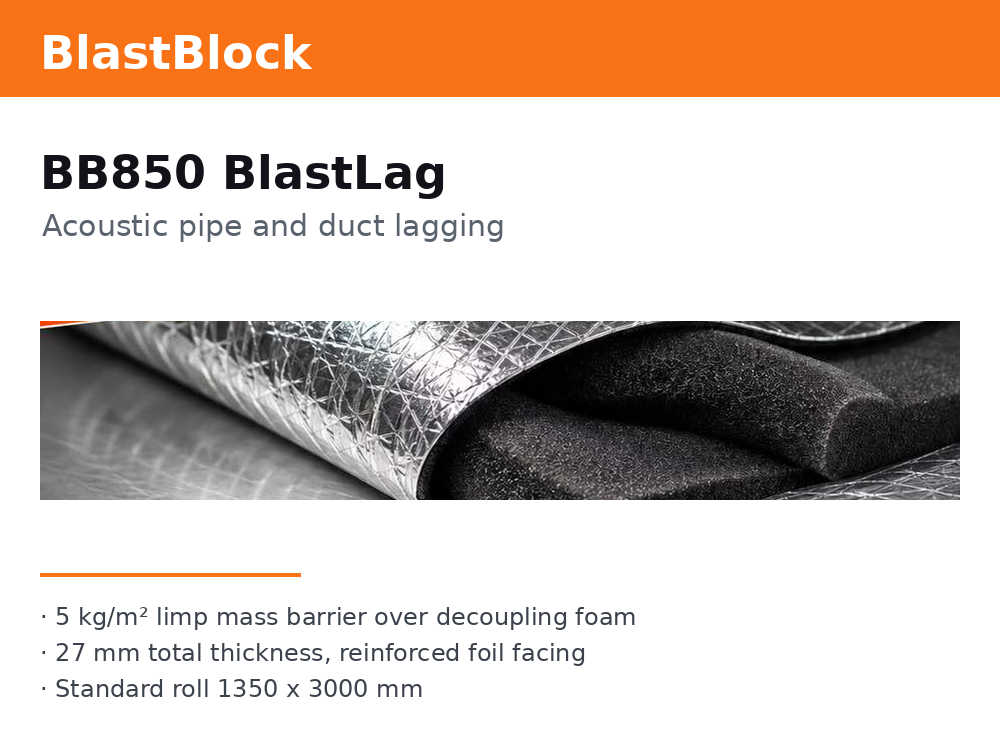
BlastBlock BB850 BlastLag is an acoustic lagging for pipes and ductwork. It combines a 5 kg/m² limp mass barrier with a hydrolysis-resistant open-cell polyether polyurethane decoupling foam, protected by a reinforced foil facing. The foam breaks the vibration path between the pipe wall and the mass barrier, so the barrier can work as a limp layer rather than being driven directly by the pipe. BB850 is intended for noise break-out from PVC soil stacks, waste and hydraulic pipework, and from sheet-metal ductwork, where lightweight modern pipe materials radiate noise that cast iron once contained. It contains no mineral fibre, so there is no fibre release or settlement over time. Performance figures are the manufacturer’s declared data; the supporting test report is available on request.
- Limp mass barrier with decoupling foam core
- Manufacturer-declared insertion loss up to 25 dB(A) on 100 mm PVC pipe
- Hydrolysis-resistant open-cell polyether polyurethane foam
- Reinforced foil facing for a durable, jointable surface
- Fibre-free — no mineral fibre release or settlement
- AS 1530.3 indices 0 / 0 / 0 / 1 (ignitability / spread of flame / heat evolved / smoke developed)
- Total VOC 0.08 mg/m³/hr (ASTM D5116)
- Wraps pipes and ducts of any diameter; cut to size on site
About BB850: Engineered for Acoustic Excellence
BB850 BlastLag is an acoustic lagging for pipes and ductwork. Its job is to control noise break-out — the sound that radiates outward through the wall of a pipe or duct into the room it passes through.
The problem is a modern one. Cast iron soil stacks were heavy and well damped, and the pipe itself did much of the acoustic work. PVC and HDPE replaced them because they are cheaper, lighter and faster to install, but those same properties make them efficient radiators of the noise travelling inside them. In a hotel corridor or an apartment service riser, a PVC stack can be clearly audible in the adjacent room every time a cistern discharges.
BB850 addresses this with two layers working together. A limp mass barrier at 5 kg/m² provides the mass needed to block airborne sound. A layer of open-cell polyether polyurethane foam sits between that barrier and the pipe, breaking the vibration path so the barrier is not driven directly by the pipe wall. Without the foam, the barrier is simply coupled to the pipe and adds far less than its mass would suggest. The outer reinforced foil facing protects the assembly and gives a surface that can be taped at the joints.
The foam is hydrolysis resistant, which matters in a service riser or a plant room where humidity is high and the material has to survive for the life of the building. The construction is fibre free, so unlike mineral wool lagging there is nothing to release into the air during installation, and nothing that will compress and settle over time, leaving an acoustically weak section at the top of the wrap.
Where BB850 performs: the manufacturer’s test on a 100 mm PVC pipe shows insertion loss rising steadily with frequency — modest in the lowest bands, around 10 dB at 500 Hz, above 20 dB at 1 kHz, and above 30 dB at 2.5 kHz and beyond. The overall A-weighted figure from that test is up to 25 dB(A). It is worth being clear about the other end of the spectrum: between 100 Hz and 315 Hz the measured insertion loss is only about 2 to 9 dB. That is normal for any lagging of this mass and thickness, and it is why a lagging specification for a low-frequency source such as a pump or a compressor should be checked against the actual spectrum rather than assumed from a single headline figure.
These figures are the manufacturer’s declared data. The supporting test report is available on request. BlastBlock has not commissioned independent testing of BB850 under its own name, and we would rather state that plainly than imply a certification that does not exist.
BB850 Installation Guide: Pipe Wrapping
- 1Measure the pipe circumference and add 50mm for the overlap. Measure the run length and allow for a 50mm overlap at each longitudinal joint.
- 2Cut the BB850 sheet with a sharp utility knife against a straight edge, foil face up.
- 3Wrap the sheet around the pipe with the foil facing outward and the foam against the pipe. Do not compress the foam — it must stay uncompressed to decouple the barrier.
- 4Close the longitudinal seam with the 50mm overlap and seal it with aluminium foil tape along its full length.
- 5Butt the next section against the first, overlap by 50mm, and tape the circumferential joint.
- 6Seal around brackets, hangers and penetrations. Any unsealed gap is a direct leak path and will reduce performance more than the gap area suggests.
- 7Where the pipe is supported, use acoustic hangers or resilient inserts. Lagging alone will not control noise transmitted into the structure through rigid supports.
Technical Advantages
- Decoupled construction: the foam core prevents the barrier being driven directly by the pipe wall
- 5 kg/m² limp barrier — mass where it is needed, without stiffening the wrap
- Hydrolysis-resistant foam suited to humid risers and plant rooms
- Fibre free: no fibre release during installation, no settlement over time
- AS 1530.3 indices 0 / 0 / 0 / 1
- Total VOC 0.08 mg/m³/hr to ASTM D5116
- 27mm total thickness — fits risers and ceiling voids where thicker lagging will not
- Operating range -40 to 100°C continuous, to 120°C intermittent
Common Use Cases for BB850
PVC soil stacks running past bedrooms are among the most common acoustic complaints in multi-storey residential and hotel projects. Lagging the stack where it passes occupied rooms is usually cheaper than rebuilding the shaft.
Noise break-out from waste and hydraulic pipework in patient areas, where night-time ambient levels are low and intermittent noise is most disruptive.
Pump discharge pipework, chilled water lines and hydraulic runs passing through or adjacent to occupied space.
Rectangular and circular duct carrying fan noise through ceiling voids above meeting rooms, consulting rooms and offices.
BB850 vs. Conventional Soundproofing
| Feature | BlastBlock BB850 | Conventional Products |
|---|---|---|
| Decoupling layer | Open-cell polyether PU foam between pipe and barrier | Barrier bonded directly to pipe, or thin foil only |
| Fibre content | None | Mineral or glass fibre in many lagging products |
| Long-term settlement | Foam recovers; no settlement | Fibre can compress and settle, opening a gap at the top of the wrap |
| Moisture durability | Hydrolysis-resistant polyether foam | Polyester foam degrades in humid service conditions |
| Low-frequency performance | 2 to 9 dB from 100 to 315 Hz, stated openly | Often quoted only as a single headline dB(A) figure |
| Documentation | Manufacturer's test report available on request | Frequently no report behind the quoted figure |
Frequently Asked Questions
Industry Benefits
Acoustic Consultants
Band-by-band insertion loss data, with the low-frequency limitation stated, so the specification can be checked against the actual source spectrum
Hydraulic Contractors
Wrapped and taped on site with a knife and foil tape; no specialist trade required
Hotel and Hospital Developers
Addresses the single most common post-handover acoustic complaint in multi-storey buildings
Mechanical Services Engineers
27mm total thickness fits service risers and ceiling voids where thicker lagging will not
Facility Managers
Fibre-free construction means no fibre release during maintenance access to risers