BB860
Foam / MLV / Foam Composite Barrier
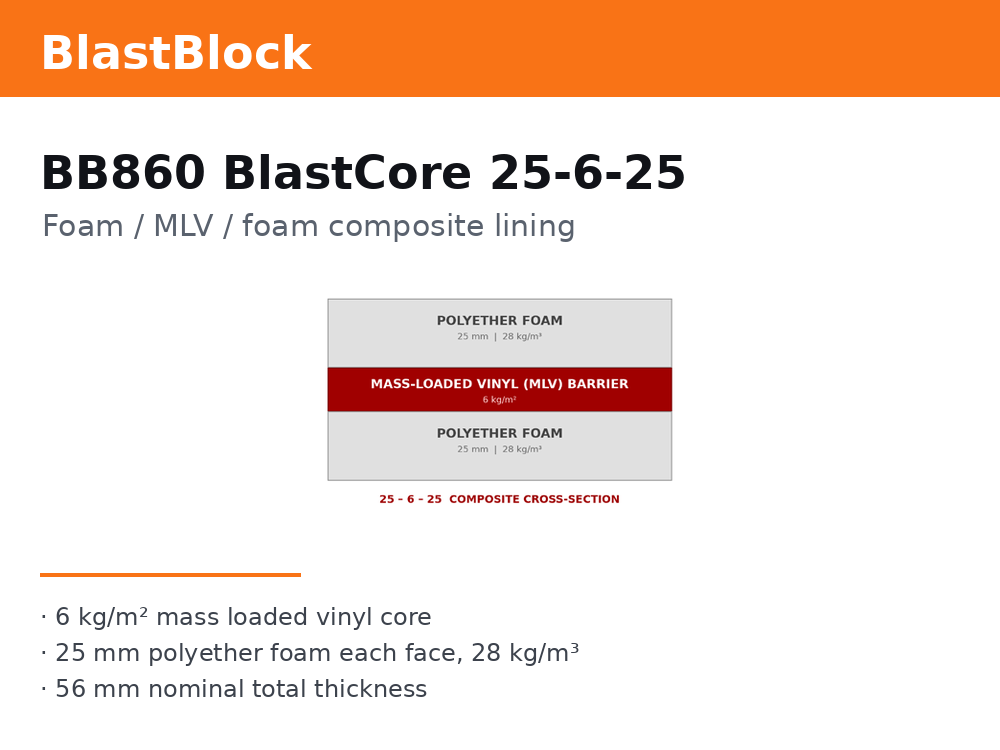
BlastBlock BB860 BlastCore 25-6-25 is a symmetrical three-layer acoustic composite: a 6 kg/m² mass-loaded vinyl barrier bonded between two 25 mm layers of polyether polyurethane foam at 28 kg/m³. The foam layers decouple the barrier from the structure and absorb reflected sound inside the enclosure, while the central MLV layer blocks transmission — a barrier and an absorber in one lining. It is intended for acoustic enclosures, generator and compressor housings, plant room linings and duct linings, where a separate barrier sheet and absorber would otherwise have to be installed in two operations. The 25-6-25 designation records the build, so other foam and barrier weights can follow as BlastCore variants. Acoustic test data for this composite is being obtained from the manufacturer and will be published here once the report is in hand.
- Barrier and absorber in a single composite lining
- 6 kg/m² mass-loaded vinyl core
- 25 mm polyether polyurethane foam each side, 28 kg/m³
- Decouples the barrier from the structure it is fixed to
- Installs in one operation instead of two separate layers
- Other foam and barrier combinations available to order
- Acoustic test report pending — no performance figures published until it is available
About BB860: Engineered for Acoustic Excellence
BB860 BlastCore 25-6-25 is a composite acoustic lining: a mass-loaded vinyl barrier sandwiched between two layers of polyether polyurethane foam.
The reason for building it this way is that acoustic enclosures need two different things at once. They need mass to stop sound passing through the enclosure wall, and they need absorption on the inside face to stop sound building up in the cavity and leaking out through every weakness. Specify these separately and you install two products in two operations, with the risk that the barrier gets fixed hard against the structure and loses much of its benefit.
BB860 puts both in one lining. The 6 kg/m² MLV core provides the blocking mass. The 25 mm foam on the inner face absorbs within the enclosure. The 25 mm foam on the outer face decouples the barrier from the panel or frame it is fixed to, so the barrier behaves as a limp mass rather than being driven by the structure.
The 25-6-25 designation records the construction exactly: 25 mm foam, 6 kg/m² barrier, 25 mm foam. The foam is polyether polyurethane at 28 kg/m³, chosen for its resistance to hydrolysis in the warm, humid conditions typical of plant rooms and generator housings in this region. Other foam thicknesses and barrier weights can be produced to order and will be listed as BlastCore variants.
On performance figures, we will be direct: there is no acoustic test report we are prepared to publish for this composite yet. We are obtaining the manufacturer's sound absorption and transmission loss data, and we will publish it here, with the laboratory and report number, when we have it. Until then this page carries construction and dimensional data only. We would rather you specified BB860 on what it is than on numbers we cannot stand behind.
BB860 Installation Guide: Enclosure Lining
- 1Set out the panel layout so that joints fall on framing members wherever possible, and minimise the number of cuts.
- 2Cut BB860 with a long-bladed knife or a hot wire, cutting through the foam and barrier in one pass against a straight edge.
- 3Fix the composite with the outer foam face against the enclosure panel or frame. This face decouples the barrier; fixing the barrier hard against the structure will reduce performance.
- 4Mechanically fix with large-head washers or battens at the perimeter and at centres suited to the panel weight. Do not over-tighten — compressing the foam defeats the decoupling.
- 5Butt adjacent sheets tightly. Seal the joints over the barrier line with aluminium foil tape or a compatible acoustic sealant.
- 6Seal around all penetrations, service entries and the enclosure door perimeter. Gaps dominate the result.
- 7Where ventilation is required, use an attenuated path. An unlined opening will set the overall performance of the enclosure regardless of the lining.
Technical Advantages
- Barrier and absorber in a single lining — one fixing operation
- 6 kg/m² MLV core provides the blocking mass
- 25mm foam on the fixing face decouples the barrier from the structure
- 25mm foam on the exposed face absorbs within the enclosure cavity
- Polyether polyurethane foam at 28 kg/m³, hydrolysis resistant
- Symmetrical construction — no risk of installing it the wrong way round acoustically
- Other foam and barrier combinations available to order
Common Use Cases for BB860
Lining the inside of an enclosure to both block transmission and absorb cavity build-up, in one lining rather than two.
Retrofitting an existing steel housing where there is no space for a separate barrier and absorber layer.
Treating the room side of a plant room wall where the structure alone does not achieve the required reduction to adjacent space.
Composite lining for large duct sections and acoustic louvre assemblies.
BB860 vs. Conventional Soundproofing
| Feature | BlastBlock BB860 | Conventional Products |
|---|---|---|
| Layers required | One composite lining | Separate barrier sheet plus separate absorber |
| Decoupling | Built in — foam between barrier and structure | Barrier often fixed hard to the panel, losing much of its mass benefit |
| Installation operations | One | Two, with the barrier joints needing separate sealing |
| Foam type | Polyether PU, hydrolysis resistant | Polyester foam, which degrades in humid service |
| Published performance data | None published until the test report is in hand | Figures commonly published with no report behind them |
Frequently Asked Questions
Industry Benefits
Acoustic Consultants
Construction fully declared, with no performance figures published until a test report supports them
Enclosure Fabricators
One lining instead of two layers — fewer operations per enclosure and fewer joints to seal
Industrial Plant Operators
Retrofit lining for existing generator and compressor housings without rebuilding the enclosure
Mechanical Contractors
Cut and fixed with ordinary site tools; no specialist trade required
Facility Managers
Hydrolysis-resistant foam suited to warm, humid plant room conditions